Thursday, August 31, 2006

Ilan Stavans' Review in Today's Washington Post

In today's Washington Post Ilan Stavans reviews Gioconda Belli's The Scroll of Seduction. He writes:
The book's best feature is the lucid English translation by Lisa Dillman. Yet the publisher doesn't highlight the translator's name on the cover, as if embarrassed to recognize that this is a foreign artifact, not coming to us in the original. This is too bad because, as it happens, translation is an inherent component of Belli's novel.
Read the rest of the review here.

Dillman, by the way, co-edited (with Peter Bush), the superb collection of Spanish literature in translation, Spain: A Traveler's Literary Companion.

Wednesday, August 30, 2006

Only in the Meantime & Office Poems

A major new book of literary translation has just been published by HOST Publications: Uruguayan poet Mario Benedetti's Only in the Meantime & Office Poems, translated by Harry Morales. Dedicated, industrious, exacting, and ever-deft, Harry Morales is one of my favorite translators-- I admire his work so much. (I am proud to say he translated Ilan Stavans' short story, "Twins" for Mexico: A Traveler's Literary Companion.) From the back cover:
Uruguay's Mario Benedetti has dazzled the literary world as a poet, novelist, essayist, critic, journalist, playwright, songwriter, and screenwriter. This first ever bilingual edition of Only in the Meantime & Office Poems introduces Benedetti's poetry to the English-speaking audience. Opening as reflections of everyday life in Montevideo, the poetry blossoms into an art which speaks to all people from all walks of life. Benedetti's extraordinary handling of irony and simplicity alongside his poetry's unmistakable rhythm make him one of the most brilliant observers of 20th century life.
Kudos, Harry!

Monday, August 28, 2006

Must we deal with hysteria? And don't forget the conference!

I read the posting on the Arabic T-shirt with some interest, as I have just been in the skies myself.

I have just returned from Germany, post the London flight scare, not being able to take water bottles on the plane for thirsty kids. I had to listen to "MOM! I'm THIRSY!" for a good hour until drinks were served. (Due to the lengthy security process, there was no time to buy a drink to finish before boarding either). Not to mention I forgot my son's luggage had a bug spray in it, which was confiscated. I felt like a criminal, and then I thought, why should I, an honest American with no intention of ever blowing up a plane, feel like a criminal because my son had a small thing of bug spray in his carryon?
My chances of being blown up in a plane are much lower than being hit by lightening, and certainly much much lower than driving I-5 from the airport. This hysteria must be reined in somehow. Normal people should not have to feel like criminals because they are flying transcontinental flights with small kids. What is the next step, flying in the nude? Obviously, not being able to wear a T-shirt is a step in that direction. And even if we were all in the buff, getting to know our fellow passangers much too well for my taste, I am sure there would be a way someone would figure out something with a nude body, so even that would not be the answer to the terrorist threat.

Within Germany there was a great deal of nervousness due to the failed attempt of the suitcase bombers on the train. For the first time ever, I saw policemen with weapons patrolling the train as we rode through Germany. For some reason, this did not help us feel safer, on the contrary. However, we could bring water bottles on the train.

Meanwhile, the German literary scene was filled with rants against Gunther Grass and his failure to disclose his Waffen SS background. It was the front page news for days.

But the ALTA conference is coming up in only two months, so my attention is turning away from Germany and back to our upcoming conference. You should be able to see the preliminary schedule on the website: www.literarytranslators.org and we are looking forward to seeing many ALTA members and visitors there. Please register today!

Saturday, August 26, 2006

Vittoria Colonna translations on the web

Ellen Moody has a beautiful translation project up on the web: Amaro Lagrimar: The Poems of Vittoria Colonna. I haven't read it yet but on first glance it looks very interesting. Moody provided a nice bibliography with this project as well.

Wikipedia has a short biography of Vittoria Colonna with some historical context.

I find myself thinking I should do this with a bunch of the writers I've been translating (at least the public domain ones.) Also, for anyone I work on - living, dead, public-domain-dead, or alien visitor from the future - I should make a Wikipedia entry in English and one in Spanish. Editing the Wikipedia is not difficult. You can learn to do it in an hour or so.

Ideally, an online compilation like this would be part of a greater whole, structured for flexibility and feedback. My ideal social software application would allow for this but would be more structured than other collaborative textual collections like Wikipedia. For example, wouldn't it be nice to be able to comment on each poem, the way you can comment on a blog? And to tag the poems with notes, keywords, associations, the way you can tag photos on Flickr? And to generate a page or a file with all the poems by a certain author, or from a particular locality, or subject, to download in plain text to your own computer?

Wednesday, August 23, 2006

Arabic on a tshirt

Writer and activist Raed Jarrar was stopped and harrassed in New York's JFK airport for wearing a t-shirt that said "I will not be silent" in arabic script.
He said "people are feeling offended because of your t-shirt". I looked at my t-shirt: I was wearing my shirt which states in both Arabic and English "we will not be silent".

and then later in the questioning of Raed in the airport by this Inspector, other officials, and employees of Jet Blue airlines:
. . . so inspector Harris answered "you can't wear a t-shirt with Arabic script and come to an airport. It is like wearing a t-shirt that reads "I am a robber" and going to a bank". I said "but the message on my t-shirt is not offensive, it just says "we will not be silent". I got this t-shirt from Washington DC. There are more than 1000 t-shirts printed with the same slogan, you can google them or email them at wewillnotbesilent@gmail.com. It is printed in many other languages: Arabic, Farsi, Spanish, English, etc." Inspector Harris said: "We cant make sure that your t-shirt means we will not be silent, we don't have a translator. Maybe it means something else". I said: "But as you can see, the statement is in both Arabic and English". He said "maybe it is not the same message".

Wow... just displaying something in a non-English language makes one a terrorist. Good to know! Ignorance reaching new heights. Apparently many people called airport security to report being disturbed or scared by Raed's tshirt. What if *gasp* he had been reading a book ... in Arabic?

Tameme Call for Submissions Deadline August 30th

Tameme has call for submissions out for translations of Mexican poetry, fiction, or creative nonfiction. Deadline is August 30th. For details, click here.

Tuesday, August 08, 2006

Venuti article on the cultural trade deficit

Larry Venuti writes on translation from English to other languages and cultural imperialism in "The Cracked Glass" in the Times Online.
American publishers reap huge profits from the sale of their books overseas, but they invest appallingly little in the translation of foreign books. The charge of cultural imperialism does not seem all that exaggerated. Some observers might go further: the patterns established over the past fifty years have apparently created American readers with provincial tastes, unable to appreciate work from foreign cultures and beset by feelings of inadequacy when confronted with it.


Good food for thought there, and it can be pushed even further. Venuti stops at a point of pondering over Joyce's cracked looking glass of the servant:

I take Joyce’s resonant words as a metaphor for translation at the present moment, when English is the most translated language worldwide, but not much translated into, when American culture dominates the international marketplace, but is so inhospitable to foreign films and books.


More on this later. Discuss...

Wednesday, August 02, 2006

Translation conference in Beirut, Lebanon, is postponed

International Federation of Translators (IFT/FIT) headquarters in Canada has notified ALTA, an affiliate member of FIT, that the Second International Translation Conference, "Translation, Transnation," which was scheduled to take place in Beirut, Lebanon, from September 18 to 20, 2006, with the cooperation and assistance of FIT, has been postponed. Information concerning a rescheduled conference date will be sent to ALTA and other affiliates as soon as that information is known.

Saturday, July 01, 2006

Mexico: A Traveler's Literary Companion --- Eight Diagrams and La Sombra del Sabino

Mexico: A Traveler's Literary Companion, my anthology of Mexican fiction and literary prose, has been out since March and I'm still doing all I can -- and thanks to all of you have been cheering me on-- to help this amazing writing find the readers it deserves. There are 24 writers collected here, among them, Ricardo Elizondo Elizondo (tr. Geoff Hargreaves), Ilan Stavans (tr Harry Morales), Carlos Fuentes (tr Alfred MacAdam), Julieta Campos (tr Leland H Chambers), Pedro Angel Palou (tr Daniel Shapiro) and Jesus Gardea (tr Mark Schafer). My own translations are of fiction by Araceli Ardon, Monica Lavin, Fernando del Paso, Agustin Cadena, and Juan Villoro, and a memoir by Guadalupe Loaeza. (The full table of contents is here.) Two bits of news: One of the most interesting and widely read literary blogs, Eight Diagrams, has just posted an interview with Yours Truly about the book and literary translation. And next Saturday July 8th I'll be presenting the book at La Sombra del Sabino, a wonderful Spanish and English bookstore in Tepoztlan, near Cuernavaca. More info about the event here. So if you or anyone you know is in town, please come by!

Friday, June 30, 2006

Text messages on cell phones

Chris at Diacritique, a bilingual French/English blog, has an interesting post about interpreting a cryptic message from his landlady:
Pocket go big bag on kitchen floor can be pulled off stems and 10 mins soak go cold water will revive it


It's a cool example of translating with context (and likely mistakes) in mind!

I see text-message Spanish all over the net, usually featuring "k" for que, and similiar substitutions that are easy to type on a cell phone.

Friday, June 16, 2006

ALTA member spotlight #1: Inara Cedrins


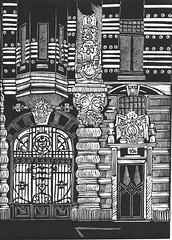
block print by Inara Cedrins
Originally uploaded by Liz Henry.

I'd like to interview or spotlight new ALTA members each week, if I can, on the blog. This might build up some nice excitement for the upcoming ALTA literary translation conference this fall!

This week I'm happy to introduce Inara Cedrins, an American artist, writer and translator from the Latvian. She was a member of ALTA when it first started, but left writing and translation for years to become an artist for the next twelve years. (Welcome back to ALTA, Inara!) She did publicity for galleries, studied for her M.A. in Arts Administration, and has now returned to writing.

There's an excerpt from her upcoming anthology of contemporary Chinese poetry, here online at thedrunkenboat.com. And right now her exhibit of linoleum block prints, "Riga Facades", is open right now in Riga. They'll be used to illustrate another of Inara's forthcoming books, Fugitive Connections, published by the Virtual Artists Collaborative in Chicago.

It's inspiring to me to see the range and depth of the work of many translators. Inara has tons of projects and clearly does a lot of work for her communities! As I added links and googled Inara's work, I came across this lovely poem: Fresh Snow and Lace, which is not a translation but which I think poetry translators might especially enjoy. I read it and saw the (unspoken) lacy-bitter inside of the pomegranate.

Rather than do an online interview, Inara wrote up a description of her projects, so I'll just give you that, and will add some links and markup. She answers most of the questions I would have asked in the interview about her projects and plans.


I repatriated to Latvia a year ago and have started a literary agency in Riga called The Baltic Edge to represent writers in the Baltic countries, Sweden, Finland, Poland and Siberia. I am personally working on an anthology of Baltic poetry (Latvia, Lithuania and Estonia); I edited an issue of the online magazine Omega featuring Latvian poets (accessible at www.howlingdogpress.com/OMEGA05 ), and am developing it from that. I will edit a future issue of the online journal The Drunken Boat featuring Estonian poets.

I plan to edit and translate in the next year a collection of Latvian prose poetry, including twenty poets with five poems by each; I'm in contact with poets in Lithuania and Estonia, and with translators who could do a parallel book for each country. These books could be a boxed set; since the Baltic poetry anthology has some 200 poems in each section, perhaps it could also be three books in a boxed set.

I spent the past seven years in China and Nepal, and have an anthology of contemporary Chinese poetry very near completion; it has sections for mainland Chinese poets, minority poets in China, poets in Hong Kong, Macao, Singapore and Taiwan, each to be introduced by an essay. An issue of selections from this, plus chapbooks featuring individual poets/projects, will form the spring issue of The Drunken Boat, online in about three weeks. The Atlanta Review has asked me to be contributing editor for their 2008 Chinese issue.

I went to China in 1998 to learn to paint on silk, and remained for five years to teach writing and lecture on art at universities including Tsinghua University and Peking University in Beijing, as well as to the People's Liberation Army and students at the Central Academy of Fine Art. I had two chapbooks of poetry published bilingually in Chinese and English by the Chinese Literature Press in Beijing, about China and Egypt: I had planned to follow these with one focusing on India (Honey Water in the Harsh Palace, completed and translated into Hindi) and one on Nepal (Sky Womb, in progress, I would like it translated into Nepali). I would like the chapbook about Egypt, titled Afterlife, to be translated into Arabic, and would like it republished, along with Snake Alley with the Chinese translation in the traditional characters still used in Taiwan and Hong Kong (I have this conversion). In 2003 I relocated to Nepal where I studied the technique of thangka painting, wrote a book on Symbols and Gods of Tibetan Buddhism and Hinduism in Nepal for Pilgrims Press and coordinated the illustrations by a Tibetan thangka painter and a Newari artist. Upon the king's coup d'etat fourteen months ago, I left with my Nepali husband, and came to Latvia.


I have a manuscript of my own poetry written while in China, called Buried Wine, have completed a manuscript of short stories written during and about my time in China, and am working on a trilogy of novels based there, in Beijing and Guangzhou, and encompassing journeys through China, Tibet, Nepal and India; the first, titled The Hotel Sunshine, has been accepted for publication by Petergailis in Riga and will be translated into Latvian. I also have a manuscript of poetry titled Fugitive Connections; the first section, relating to Latvia, has been translated into Latvian. I am beginning a collection of poetry set in Europe. My writing has been referred to as "the saga of a female Odysseus"; each of my collections of poetry brings the reader a complete absorption in a culture.

My first anthology, Contemporary Latvian Poetry, was published by the University of Iowa Press in 1981; my chapbook of translations of the poetry of Astrid Ivask, At the Fallow's Edge, was a Small Press Book of the Month Club selection and went into a second edition. My poems, stories and translations from the Latvian have appeared in The North American Review, Chelsea, Prairie Schooner, The Portland Int'l. Review, The Ledge, The Minnesota Review, Translation/ Columbia University, the Massachusetts Review, Kansas Quarterly, The Atlanta Review, New Letters and The Chariton Review, among others; online poetry journals include Writing Macao, poetrybillboard.com, Omega 3, 4, 5, Howling Dog Press, and the Atlanta Review.


I am now a member of the Latvian Writers Union. I teach Creative Writing at the University of Latvia, and have been asked to teach a course in translation, and one in American, British and World Literature and Drama, in the future - I have written a textbook for the latter which they plan to publish.


I am having a great deal of trouble finding publishers for poetry, and would appreciate it if your profile would draw attention from a publisher. Also, I am looking for translators of my poetry chapbooks into Arabic and Nepali; possibly the description of my work would attract someone?


I'd like, too, to include the announcement of her June 2006 art show in Riga:

Maksliniece Inara Cedrina un
Ipasu uzdevumu ministra sabiedribas integracijas lietas sekretariats
Ieludz Jus uz izstades
RIGAS FASADES (grafika) un zida gleznojumi (sena Kinas tehnika)
atklasanas pasakumu 2006.gada 8.junija, plkst. 16.00
Blaumana iela 5a, 5.stava, Riga
Izstade bus apskatama lidz 2006.gada 23.junijam no plkst.9.00 lidz 16.00

Inara Cedrins and the Secretariat of the Special Assignments Minister for Social Integration invite you to an exhibit of
RIGA FACADES
linoleum block prints
and Chinese ink on silk paintings
Opening June 8th 4 p.m.
Blaumaòa iela 5a, 5th Floor, Riga
Until June 23rd
Weekdays 9-4

Thursday, June 15, 2006

Over at "Conversational Reading": A Post on Archipelago Books

One of my favorite litblogs (translation: check it out!) is Scott Esposito's Conversational Reading. Today he's posted a little something on Archipelago Books, publisher of literary works in translation.

Monday, June 05, 2006

literary blogging

This is a year-old USA Today article, but it's got some interesting points about literary blogging in the English-speaking world, and especially on how it's helping to expose interest in books in translation:

What many blogs do better than the conventional print media is offer a sense of the global literary culture by providing links to foreign book coverage.

Moorishgirl.com, run by Laila Lalami of Portland, Ore., focuses primarily, though not exclusively, on fiction from the Arab world and South Asia. Another site, www.complete-review.com, dedicates a specific blog to literature in translation.


Are we moving closer to a global literary culture? I think blogs have the potential to help lessen US-centrism, at least.

Friday, June 02, 2006

Science fiction, translations, cultural appropriation

At Wiscon 30, Madison's feminist science fiction convention, I came across the issue of language and translation many times.

Here's my rough transcript of the panel "Laádan vs. tlhIngan Hol: Differential Diffusion of Created Languages", in which the woman's language invented by the author of Native Tongue was contrasted with Klingon. It was a spirited discussion. One audience member talked about her own feeling that she did not need other languages than English to express any possible thought. Suzette Haden Elgin, with a mild bite to her reply, answered, "Millions of people agree with you." The general consensus of the room was that cross-language fertilization keeps everyone's ideas fresh.

At another panel on "So-Called 'Third World' SF", audience members talked about how much they want to read science fiction from non-English speaking cultures. Apparently the sf magazine with the highest circulation is in China. "Why doesn't anyone translate that stuff? We want to read it!" was the general consensus. It was a room full of hundreds of people, so I didn't pop up and talk about copyright problems.

Another panel, "Cultural Appropriation and Writing Fantasy Outside Western Tradition," looked at the ways that many invented mythologies use European myth as their source. What about when they don't - when someone writes about techno-Aztec gods, or Chinese dragons and nine-tailed foxes? What are some things to think about in regards to cultural appropriation, "authenticity", and exploitation? An extremely lively and intelligent discussion is happening this week, and here is a roundup of some entry points into the debates about race, culture, ethnicity, and (if not direct translation of languages) translation of cultural elements.

In this discussion, oyceter says:
...no one is ever going to tell you that cultural appropriation is ok or that there is a way for a dominant culture to write about a minority culture without these problems rising up. If they do say that, I'm sorry, they're lying or they're from the far future, in which there is no race disparity, no racism, and all nations are on equal economic, political and cultural standing.

This does not mean you shouldn't write about it.


These same issues are important in the world of literary translation. It always comes up for me when it comes down to getting the rights to publish in translation. If someone in Uruguay wants $200 per poem (as they did for some of Juana de Ibarbourou's) and I bargain them down on the grounds that my work was a labor of love, I don't have any money, and I'll never make a penny off my putting these few poems into an obscure literary journal that's probably also losing money like crazy. At the same time, I'm aware that I can be said to be "making cultural capital" out of my translations over time, and so it would be exploitative for me to expect to get the rights to the poems for free or cheap. As oyceter says, there's no easy answer.

Meanwhile, I was on a panel with Ursula K. Le Guin, but didn't have the nerve to go up to her later and talk with her about her translation work with Diana Bellessi! I had a shy moment there - plus, she was always surrounded by starry-eyed fans.

Tuesday, May 30, 2006

In the Company of Dead Languages

Ola Wikander has written a book called "I döda språkets sällskap" (ie "In the Company of Dead Languages") which I am reading right now. One item of note that I have gleaned in this book: the world's first known named author is Enheduanna, a Sumerian woman, writing in 2300 BC. And the first grammar is a Sumerian one, written for speakers of Accadian, who needed to know Sumerian after conquering Sumeria and in the process taking on Sumerian culture (by the way, ancient Sumeria is located in the area we now know as Iraq, and one of the pieces of writing in Sumerian, a stele, talks about a horrible war, the worst known ever, in which hundreds of men took part! How times have changed, now we have hundreds of thousands).
I was interested in Wikander's book, since I've studied a number of dead languages myself over the years, under the tutaledge of Joe Voyles, a professor of historical (Indo-European) linguistics. If the language is dead and Germanic, I've done it. Old Saxon, Old Icelandic, Gothic, Old English...
Studying dead languages puts a perspective on the language issues of today. What we speak as English is a language that the writer of Beowulf never could have imagined, and Shakespeare would also be hard-put to understand our babbling away in modern American English. In five hundred years, the language we now call modern English will be something else. No amount of wishing otherwise will change the fact that English never was a pure and stable linguistic phenomenon, and it will continue to change, differentiate, and, most likely, become a classical dead language.
The language Beowulf spoke almost a thousand years ago is, except for a die-hard enthusiasts, is as dead as dead can be, hence the need for Seamus Heany's translation. In five hundred, six hundred, seven hundred years, students of Classical American English will be sweating over their dictionaries, trying to figure out what the heck we were writing about. Or if they managed to tranfer DVD technologies, what we were talking about.
The language ideation in the United States, what with the recent legislative action and the brouhaha about the National Anthem in Spanish, is a lost cause from the beginning. Our great-grandchildren will be speaking something else than the English we speak today anyway (just a quick glance at Lincoln's Gettysburg Address will bring to mind much change we have already encountered in American English over a mere 140 years).
On the other hand, English, even as it changes, is the language of success in this place and at this time, which is why I think that folks who intend to live here for the rest of their lives have an obligation to learn it, just as someone moving to Sweden ought to learn Swedish, or learn French in France, or Spanish in Argentina, or Chinese in China. But in the end, all language is a living process that is constantly changing, constantly adapting, and becomes something other than what we ourselves speak (or, rather, once we're gone and buried, have spoken). Then our children and children's children will have issues of their own with the language policies of the day.
Does anyone remember that English won over German as the language to be used in the United States by one vote? Certainly the dominance of German in the United States has changed from the 1780s to now, and the issue of whether the national language should be German has definitely died out, along with the large number of colonists who spoke it, though their great-great grandchildren live on speaking an English they would not recognize from their own era. The dominance of German as the second language spoken in the United States lasted for a long time, though, I must point out. Its place as the mother tongue of a great number of Americans did not end until 1960. By the 1970 census, Spanish had overtaken German for the first time. During the First World War, German speakers were encouraged (if that is the right word in this context, since laws were made and books were burned) to switch to English in church services, newspapers and book publishing, which was the beginning of the end of American-born native German language speakers. No one born now would ever imagine the huge presence German once had here in this country.
And a thousand years from now?
The American English that we speak will have vanished. As all the languages now being spoken will have mutated into different forms, different sounds, different expressions. (Even, maybe, Icelandic will change!)
It's inevitable.
Sumerian, anyone? Or Accadian?
Or for that matter, Beowulf? Chaucer?
Dead languages have much to say about the future of language.

Sunday, May 21, 2006

The Book of Hours / Libro de Horas

No exaggeration: this is one of the most beautiful books I have ever seen: Poems and paintings by one of Mexico's most original and accomplished artists, Alfredo Castaneda, translated by the greatest living translator of Mexican literature, Margaret Sayers Peden. But-- oh, this world of Philistines!---it does not have a US distributor. Margaret tells me it can only be purchased from Castaneda's gallery in New York, Mary-Anne Martin Fine Arts. It was published by Artes de Mexico and has a prologue by Alberto Ruy Sanchez. (Ruy Sanchez's essay on Oaxaca, by the way, appears in my anthology, Mexico: A Traveler's Literary Companion.) In the prologue, Ruy Sanchez writes,
The ritual of Alfredo Castaneda's Book of Hours is permeated with a modern, ironic smile, no less disturbing and profound than the questions he poses before the abyss of being. It includes poems of abounding love, of liberty, doubt, mystery, and astonishment. In its lines time blows like the wind, and the horizon speaks to us. Light literally grows brighter with each page of this volume, because it composes an illuminated space which, when drunk in by our eyes, lights our steps as we move forward through it. This Book of Hours is one of those unique works of art that inscribe their mark on time.
I couldn't have said it any better.

Sunday, May 14, 2006

Global Wording

German translator Lee Chadeayne sent this link to a very fun, very quotable article from the Smithsonian Magazine.

Friday, May 12, 2006

Swedish Translation Fun at SASS

I have just returned from Oxford, Mississippi, home of Faulkner and the most recent conference of the Society for the Advancement of Scandinavian Studies, which included a panel on Swedish translation put together by yours truly, moderated by Marilyn Blackwell and with additional panelists Johannes Göransson and Rochelle Wright.
Johannes discussed his translation of Aase Berg, and Rochelle her translation of Kerstin Ekman. A lively discussion ensued which addressed the entire spectrum of translation, such as word play, cultural context, what makes a "good" translation (ie readability versus accuracy) and Swedish peculiarities.
The never-ending question of readability versus accuaracy is one in which I will now add my two cents. I am all for readability first and foremost, with accuaracy an accessory to art but not its master. When I translate a work, I want the emotional impact of the original to resonate with the reader of the translation. If that is sacrificed to accuracy, art dissapears. We are not solely intellectual beings, but also emotional and spiritual ones, and these latter aspects of humankind are just as important to a work of art as the intellectual satisfaction. When folks ask how I see my work of translation, I call it "gut-to-gut" translation, meaning that the whole person must be included in the work of translation, whether as translator or as reader of translated literary works.
A work of translation cannot be entirely accurate, because the entire cultural context cannot be translated. If the reader understood the entire cultural context, they would also be reading the work in the original, since language is part of culture. At best, we translators are approximating the original as best we can into a new cultural context, and we must take the cultural resonances of the new language into account. A translation is a glimpse of another place, but cannot take the place of the original language. But translate we must, since we love the original so much that we do not want our own culture to miss out completely on the literature that we love. Without translation, our readers would never see the worlds that our authors have created.
Criticising a translation is like shooting fish in a barrel. There is always something to find that is not to the critic's liking, and we translators must develop a tough skin to withstand the withering critiques that are inevitable. There it is, that's life.
Back to translating now, hard workers in the field of literary transfer!